
Beta — tested on Debian 12 & 13, feedback welcome
The panel that makes BIND9 manageable.
Authoritative DNS on Debian 12 & 13, in one panel. Per-zone master/slave/forward with conditional forms, one-click DNSSEC (KASP) with DS records ready for the registrar, curated RPZ threat-intel feeds plus your own custom feed URLs, live propagation check across Cloudflare and Quad9. Files are the source of truth — no database, vim is a first-class editor.
Free for personal and non-commercial use — home labs, learning, self-hosting your own DNS. Commercial deployments (paying clients, for-profit production) require a NetForge license — see the terms.
The panel in one minute
Why nomina
DNSSEC in one click, with DS export
Toggle dnssec-policy default; on a master zone
and BIND auto-generates KSK + ZSK in
/srv/nomina/dnssec/<zone>/ within a
minute. nomina computes the DS records (SHA-256 + SHA-384)
and shows them ready to paste at the registrar — drift
detection included.
RPZ threat-intel out of the box
Curated feeds (URLhaus, Hagezi, OISD, NetForge mining) toggle on/off with a checkbox. Drop in your own feed URLs for private blocklists. Whitelist plus a custom block list as top-level overrides — fix a false positive in one place instead of disabling a whole feed.
Files, not a database
Zones are .json sidecars next to BIND zone
files. Admins are admins.json. Audit log is
.jsonl. RPZ lists are zone files. Vim
them. Edits round-trip cleanly to the panel — no
schema migrations, no hot-copy backup gymnastics.
Dynamic DNS for hosts without a fixed IP
Allow a host — say home.example.com — to update
its own record with nsupdate, signed by a TSIG
key that can change only that name and those types. The
panel hands you the key file, a ready script (current IPv4
/ IPv6), the cron line and the dig to check it.
TSIG keys and a hidden primary
Create or import TSIG keys in the panel and name them in a zone: a secondary on a home connection, with no fixed IP, pulls the zone by signature instead of by address. Keep the primary hidden — in the SOA, out of the NS — and let public secondaries such as BuddyNS answer the world.
Transfers you can read
Every zone shows who copied it, with which key, and who was refused — read from BIND's own log, with what the error means. Secondary zones show their serial, next refresh and records. NOTIFY, reload and retransfer are buttons, not SSH.
The chosen stack
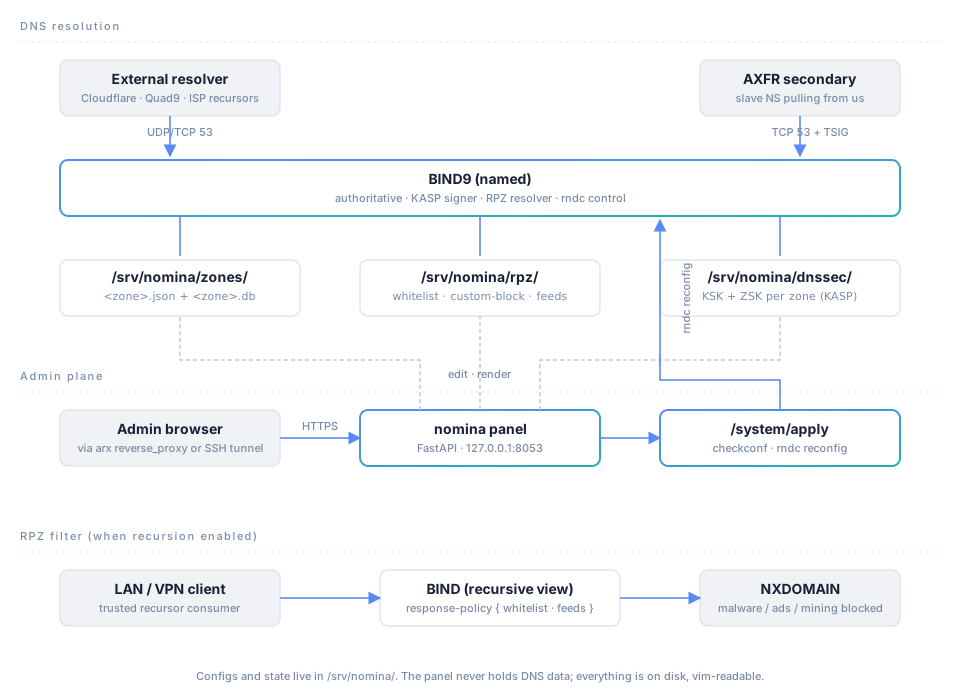
How a query flows through nomina
Two lanes — inbound (the world resolving your zones) and admin (you editing them). Same daemon, same SQLite-free state, no extra moving parts. Each blue-bordered box is something the panel renders config for and you can read on disk.
Part of the NetForge family
nomina doesn't try to be everything. Two sister panels handle what's not DNS — together the three cover hosting, mail, and naming on a single self-hosted box.
arx
Hosting panel. nginx + PHP-FPM, per-site outbound firewall, WireGuard admin plane, Squid SNI filter. The HTTPS edge that fronts nomina (and missus). arx.netforge.it →
missus
Mail server panel. Postfix + Dovecot + Rspamd. SMTP, IMAP, DKIM, granular backup. Pairs with nomina to handle the MX records on your domains. missus.netforge.it →
nomina (you are here)
Authoritative DNS. BIND9 + KASP + RPZ + propagation check. The naming half of the triad. arx + missus + nomina = self-hosted home base.